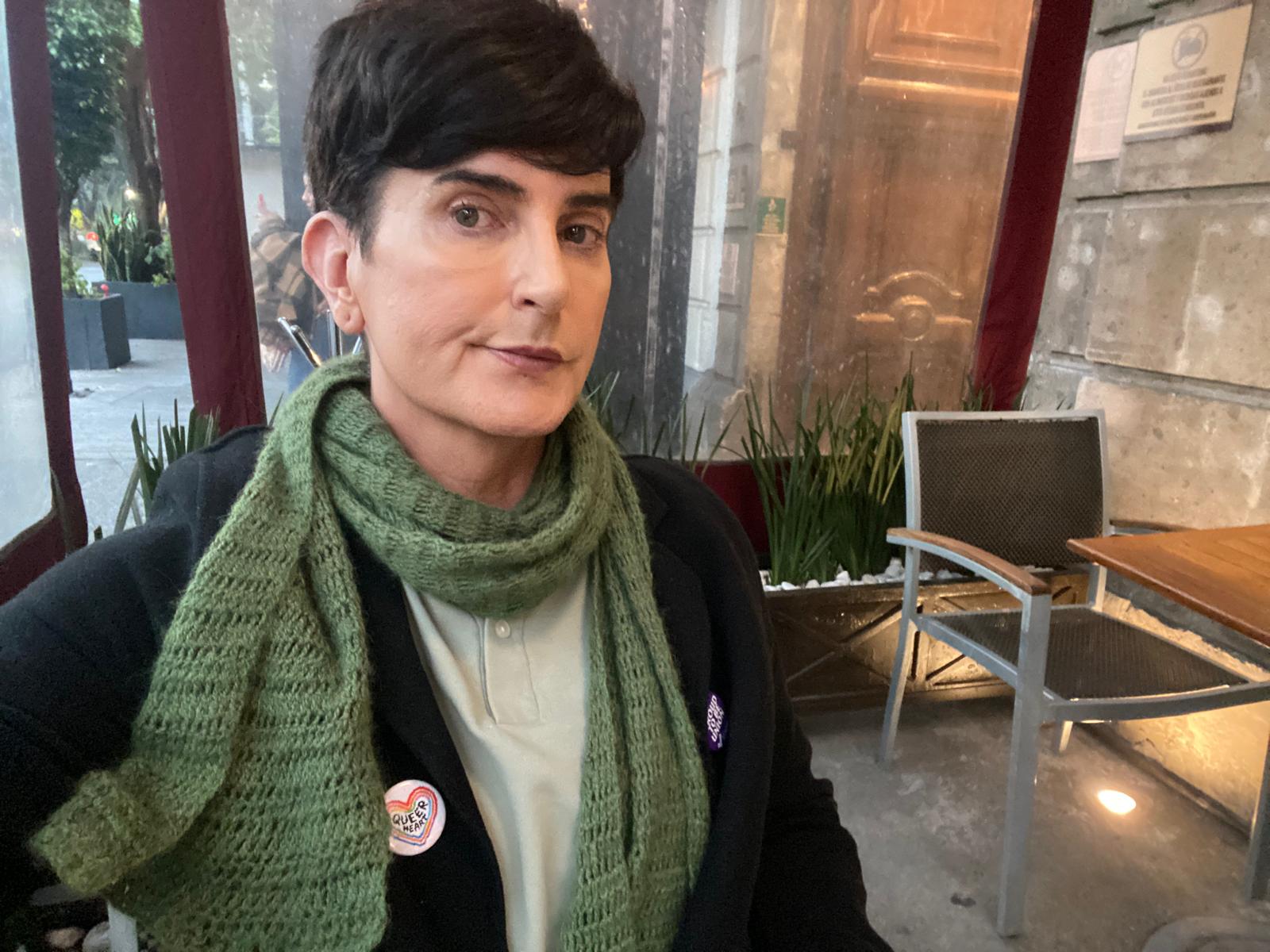
 Vek Lewis is a writer of Anglo-Indian heritage who grew up in Goolamrup, Whadjuk Noongar Boodjar, in Armadale-Kelmscott, an outer suburb of Perth, Western Australia. She currently lives on Gadigal Country in Sydney. Lewis has published poems and short stories in Cordite Poetry Review, Meniscus Literary Review, and has work forthcoming in Westerly.
Real Estate
We had no money, and no quick means of getting it.
To make matters worse, no real estate in town would even consider our application. Every receptionist aped the other, smiling moronically behind painted lips and lacquered dead hair. Yes, we’ll telephone you as soon as the owner has reached a decision. No, the matter is yet to be finalised. Yes, you can try phoning on Friday at midday if you like, we should know by then. No, the house hasn’t been leased to anyone yet, please be patient. Wherever we went, the same old tune. We had references, yes. We had the foresight to be creative, to put it another way, with our sources. What else could we have done?
I was beginning to realise we had nowhere to go. And staying at the hotel – famous for its family feel of psychotics in adjacent rooms and drunk wife bashers across the hall – could only last so long. Till tomorrow, that is. Between us, we had not a cent to our names.
Salome was optimistic. I found myself slipping into a vague state of panic. Four months in Melbourne, having torn away from Perth, already I’d landed in this mess. At least there was Salome.
I rang a housing crisis line, only to be given four names, all of which turned us down. No, we don’t have any spaces, sorry or We cannot house friends together anyway was the customary dismissive response. It was like doing the rounds with the real estate again.
I rang the last contact on a list given me by the Salvation Army. It got through.
– Come and see us for an interview tomorrow at 1:45. My name’s Maria, I’m the housing officer, and we’ll see what we can do. Do you know where we are?
– Yes, St Kilda, right?
– Fitzroy St. Good, see you then.
Some consolation. I would do anything to get into this program. Otherwise, I knew, things would surely spin out of control.
I turned up ten minutes early to the appointment.
A woman, wearing a red vinyl jacket and with her black hair in a corkscrew perm, in her thirties, was smoking a cigarette out the front of the Centre. I assumed she was a client. As I approached, she looked at me a little quizzically, then leaned forward.
– I’m Maria.
– Oh, hi, yes. Am I late?
– No, you’re early. I’m just having a fag. Why don’t you come in and sit down. I’ll be with you in a sec, OK?
– Ok, thanks.
I sat there, flicking rapidly through piles of Woman’s Day and New Idea, not really reading, but taking in the headlines and the blurry exclusive photographs. Melanie Griffith and hubby Antonio caught nude on beach. Madonna hits out at anti-fur campaigners, Robert Downey Jnr on drugs – again. I only digested the large print, mulling over my own story, which would have to be equally sizzling, controversial, I thought, to be taken seriously by these social workers. They saw all types. Some of them worse off than me, probably. What was my case? I felt a sharp sense of guilt, akin to when I’d get called a whinger at home, for any and everything, such was my reputation. Weak, spoiled, girl. More often than not, overheard words. My father’s. Maybe it was true. I had nothing to complain about. I broke out in a sweat, my stomach grumbled.
I would have to be as creative as any subeditor of a scandal sheet. The public had to know, didn’t they? I saw myself in one of those articles, framed in red Story of a runaway was one headline. Another brave victim speaks out.
I laughed at the corniness of it.
Hadn’t I lived a normal life? I was alive. I predicted their responses: come on, you’re bright, emphasise the positive (as my mother might say) or more brutally, we only help those who can’t help themselves. I felt like leaving. I was a phoney, a fraud. I had nothing to say. I had never suffered. I had brought all misery upon myself.
Before I could get up, Maria entered the waiting-room.
– You can come through now.
Maria offered me a coffee, which I declined, politely. I did not want to feel more jittery than I was. A valium might have helped. I rooted myself to the metal chair. Maria introduced me to a blonde woman in a seat next to her, by the name of Carol. Carol was extraordinary. She wore several layers of pancake, and over her lips had applied bright-red lip liner which finished in two alpine peaks on the top. She was my “worker” proper (they never said social worker) and I would be seeing her every week. She would look after my needs, and assess my weekly progress. Carol was the source of much gossip among the “kids”. On her left cheek, under the layers of frosted foundation, you could discern evidence of a slight scar, about an inch long, which she did her best to hide. Watching her talk was weird, and I tried to stay serious. That was vital today. I couldn’t show any degree of light heartedness here. That was not on the script.
– Hi there. Just a few questions to begin. Maria tells me you’re from Perth. How long have you been in Melbourne?
– Yeah, I moved from Perth about 4 months ago, so I’ve been living here since February this year.
– Mmm. Since this year. February 1992. Right. Any family?
– They live in Perth.
– Do they know that you live here? Is it possible for you to get any support from them?
– No, I left without saying good-bye. And no, they wouldn’t support me. They can’t. I mean – they’ve never really supported me…
– Financially…?
– No, I mean yes, that, but in all other ways. We don’t have what you’d call “a good relationship” y’know, me and my parents.
– So you don’t get along with them, not even with your mother?
– That’s what I said.
In that moment, I felt as if I had dealt my mother a swift blow. I was like Peter denying her three times. I never knew you. I never knew you. I NEVER LOVED YOU. Not the way someone should treat their mother. Judgement weighed heavily on me. It was irreversible. There was no point holding back. I’d already contravened the Universal Law.
Wasn’t I, myself, an aberration? This is perhaps something this woman could never comprehend. She was part of the normal – the acceptable – world. She had a family, parents who loved her, paid for her education. What separated us? I had come here to find somewhere to live, all other doors had been slammed in my face. But I would have to reduce myself to visual rubble to get anywhere. A cry nearly cracked its way through to the surface, but I scotched it. I bent my head down, talking to the carpet. Here as usual I was giving account.
What did she see, looking at me? Why couldn’t they just get it over and done with? They would probably say no, they couldn’t help me just now. Suddenly I sensed I had no place in this world. It was better I didn’t exist. There, I was helpless. Scrape me up from the floor. Wash that blood up.
– She can’t cope with who I am, I offered. This was sure to elicit some response. It was the 1990s. The talk shows were full of it. Carol looked like the kind of person who would watch talk shows. Tape them if she missed them. She would enjoy all the emotional blood and guts.
– She won’t accept that your sexuality, your gender? That word again.
– No. My mother wouldn’t accept me being anything she hadn’t planned.
– And your father?
– I haven’t told him. But he’d put me away. I’m certain.
I felt I was speaking of someone else’s life. But once I’d said those words, thinking back, they resounded with truth.
The last time I saw my mother, we’d met for lunch in the city.
It was months since I’d seen her. My mother is full of smiles and singsong cheeriness when she waves at me from the front of the station. We lunch at an Indian restaurant.
She asks the usual questions: How are you getting on? How’s the asthma now you’ve moved? Do you see many of your old friends? I answer them, mindlessly. Her conversation is nearly always like this, mindless. To my mother, small talk is pivotal. She is constantly avoiding the topic. But not today. I won’t allow it.
We finish our pumpkin dhal and I go for seconds. I need to fortify my stomach for the afternoon ahead. With characteristic aplomb, she refuses a second helping. Always the self-sacrificing one. Not one to be seen as excessive.
It’s that look of pride that I hate, the way she stares at me like I’m some object and doesn’t listen to what I say. I may as well be a Stepford Child, a good Anglo-Indian “boy”. It’s what she wants. Loyal, self-effacing.
But this afternoon she doesn’t get what she wants.
We make the journey back to the suburb, and I know it will be the last time. I am careful to ascertain if my younger brother is liable to be out or in. My mother assents. He has gone off driving in his V8 with his friends.
On the way there, I thought, this is where the rift starts, this is where I wave goodbye to my mother as a passenger on a cruise liner bound for some distant country, a long trip, possibly for life, signals goodbye to the fast-disappearing friend on the docks. I could see her as a black speck blinking on the horizon until she no longer existed, except as memory.
But no, that rift had started much earlier. It is hard to say precisely when. It was only that now some spell had been broken. I had stopped believing in her. Or so I thought.
I felt sad for this woman, who had never known me. At the same time, I was angry beyond words. Anger felt like privilege. It surged through my veins. My mother hated emotions. I began to see her beauty as the beauty of a mannequin, a wax figure. Someone who rarely breathed, she was so controlled.
I remembered those long days after I left school, half-way through the year, sleeping, holed up in my bedroom, completely lost. Seven months, seven months of walking into a coma of languidness. I would draw flowers. I drew an outline of my body, but I tore it up. My mother pushed food over the threshold, dutifully. And mail under the door. She accepted this without a word. She did not want to know.
– Glandular fever, she told her friends. Struck down, just like I was before the brother went and their father had to hire home help.
Like any commander, she schooled her cadets in the utmost self-discipline. Just a glance was warning enough. Or the threat of No-Speaks. Efficiency is the way. If there was a person down there it was lost beneath all that artifice of poise. And mimicry is the best flattery. She needed that. She, in her own way, was missing too. She rarely spoke of her parents but in the most glowing terms. For every real emotion, she had a part rehearsed. That was her survival.
But survival can be hollow.
Looking at it now, so much is laughable. Tragi-comedy, I guess. That afternoon, in her duplex, I summoned the courage to be as straightforward as possible.
– Agape, I can understand, but Eros? That is not a natural thing. What are you trying to tell me? You like men? Why cannot you just be normal? Plenty of girls like you: Annika Panicker, for example, from a good family. Or Vivian’s daughter, from church.
– Mum, it’s not about that. I just don’t feel “right”. I don’t know how I feel. Nothing in our family is normal! Are you going to tell your friends, at least? If you don’t understand it, me not being a boy, you should at least talk to them.
– I will say nothing, it’s against God. I will tell them you are asexual.
My mother looked down, picked up some knitting, and asked me when my train was due. I never saw her again.