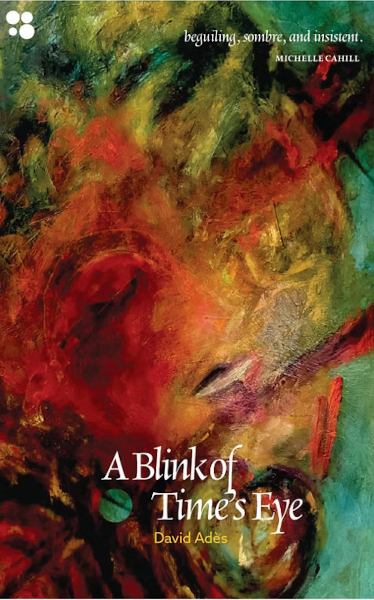
 A Blink of Time’s Eye
David Adès
ISBN 978-1-923248-15-1
Reviewed by NATALIE DAMJANOVICH-NAPOLEON
Life’s Unending Casualties
A Blink of Time’s Eye is a gentle book that invites the reader on a journey through Adès’ personal and family history, exploring the notion of time—deep time, the present day, and ancestral time—as it connects with the story of a person’s life. This is Adès’ sixth poetry collection, if we include his chapbooks, and encoded in the lyric poems within is the work of a mature poet viewing their life’s work, their mortality and the mortality of their loved ones. The fixity of time and “our variegated mazes of memory” are continually questioned by the poet in A Blink of Time’s Eye. Yet Adès remains an optimist and like the sunflowers that are scattered throughout the collection he turns towards the sunlight of life rather than its darkness, remaining willing “like this flower” to “bear witness.”
“Going On” opens the collection on a strong note. The poem examines intergenerational trauma, announcing one of the book’s themes with the line, “ —language / fails me here, the chasm between a story lived and a story told.” The Beckett epigraph announcing this poem, “You must go on. I can’t go on. I’ll go on” speaks to the poet’s recognition of the everyday struggles that are part of the human condition which he echoes throughout the collection. In a podcast with Magdalena Ball recently Adès revealed that many of the poems were written during a residency at the Don Banks Studio and inspired by his experiences during the Covid pandemic (00:01:22-00:09:44). The pull towards introspection and the reckoning of life as a result of Covid lockdowns and isolation is evident in the collection, particularly in poems such as the title poem “A Blink of Time’s Eye” with “infection toppling / the dominoes of our vectored lives” and “In This Late and Tenuous Hour” where the subject of the poem is “deprived of the intimacy of close contact”. The collective experience of time that was bent and distorted during Covid coupled with loss is encapsulated in this work.
Few male poets write as empathetically and engagingly about parenting as Adès’ and this insight provide some of most poignant moments of the collection. This is evidenced in poems such as “Washing My Daughters’ Hair” and “Such is the Gifting, Such the Receiving,” although the emotional impact of poems such as these is often undone by the poet’s habit of titling poems with either the first or last line of the poem. Repeating impactful lines robs these lines of the weight of surprise. However, the use of anaphora with the word “observe” in a poem about parenthood such as “The Myriad Lives I Live Inside My Own” is an effective tool that moves the poem along in a satisfying rhythm. In this poem Adès asserts that life is to be lived in the moment:
I replay images and moments from the day,
they are already diminished, even if I hold them
in the arms of my own joy.
“The Archaeology of Living” and “Tidal” are two poems that follow each other in the collection exploring squewiff typography that echoes concrete poetry, accompanied by abundant, experimental language to profound effect. Parenthood is invoked in “The Archaeology of Living” along with the “Rubik’s cube of perpetual departures” that affects parents of late teen children. Circling back to the prescience of survival that the pandemic pressed upon many of us Adès asserts:
Survival is such an effort,
requires so much devotion, such constant attention
it is little wonder so many fall by the wayside,
life’s unending casualties.
“Tidal” is a poem that showcases Adès’ talents as a poet at his best, and it is refreshing to read a poem where a father explores parenthood with its “chop and swell” and “wave after wave after wave” of challenges. This is a father who both “set[s] boundaries” and is also “willing the breaking of them” yet acknowledges the effort of fighting against the tide to remain afloat as a parent. Yet it not only in the present tides that Adès poems shine, but rather in his ability to look back that renders impactful insights.
The third section of this collection “Past Whispering in the Tent of Present” is a standout as it examines the effects of the Holocaust and this “catacomb of memories” on his mother’s and subsequently his own story. “Exodus” calls to mind the style of Adrienne Rich in its breadth and examination of history against the background of his mother’s personal experience:
exodus upon exodus
always leaving, lost markings hidden
though marking generation after generation.
It is an exceptional poem that holds both the past and present taught, tying the threads of his own and his mother’s life together when he returns to Egypt, concluding “it takes so / little time to be obliterated, for all the markings / to disappear.” “My Mother, My Daughter and Anne Frank” continues on a similar vein, calling to task the Nazi legacy and “one man’s demonic vision” along with the “questions asked that cannot be answered.” It is in the quiet moments that this collection excels with poems such as “Disembarking” when Adès returns to view his own life in light of his mother’s exodus. “Disembarking” unfolds the verse in tercets and standout lines such as “the day’s slow map rolls away,” reflecting on another war someone in his family, namely he, has escaped, and wondering at a world that could be “oblivious to all borders.”
The poems “Exit” and “Tomorrow” are apt as poems that bookend Adès’ collection, appearing in the fourth section “Our Lives Floating Light as Windswept Dandelions.” “Exit” explores the metaphor of falling asleep during the movie of one’s life, here the poet writes, “I wonder what living I have missed in that sleep…how the story is so much memory and so much the gaps between.” However, in “Tomorrow” the poet tells us he is not yet finished with this world, for even though it is broken he holds onto gratitude and “what we haven’t yet written / on tomorrow’s page.” Time may disappear in the blink of one’s eye, but this poet is determined to keep their eyes and heart open to life’s mysteries and joys.
Works Cited
“David Ades on A Blink of Time’s Eye.” Compulsive Reader Talks from Spotify, 29 May 2026,
https://open.spotify.com/episode/5K9nIiCLZRFvE04wbHoDyo.