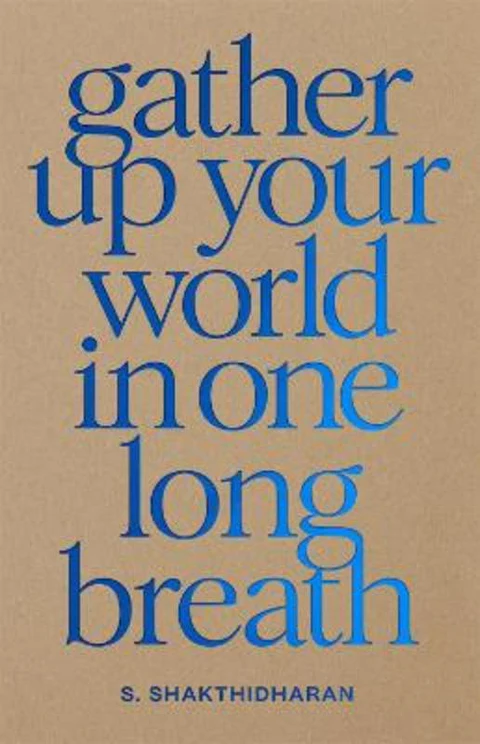
 Gather Up Your World in One Long Breath
by S. Shakthidharan
ISBN: 9780645530964
Reviewed by SREEPURNA DATTA
Gather Up Your World in One Long Breath is a sincere attempt to deliver what its title promises. “Tell me all the stories from your life, from the beginning to the end,” asks the author’s son in the opening section of S. Shakthidharan’s memoir. The following chapters provide a range of moving and unique stories from the author’s life. Shakthi’s play Counting and Cracking – which won the Victorian Prize for Literature, the Nick Enright Prize for Playwriting, and several other awards – was also based on the playwright’s personal history. Gather Up Your World in One Long Breath not only fleshes out this history further but also explores how it shapes the author’s present.
In a radio interview, Shakthi explains his approach towards telling the “stories from [his] life” through this memoir. Surrounded by his family on a busy morning of his life, he found himself wondering “why the hell [he] was feeling such joy in a time of madness and difficulty” (Knight). Here, Shakthi follows up by providing a brief answer: “It was because…this was the first time that I had been inside a family.” The memoir gears up to explore both how the author found his family, as well as what broke his family apart in the first place.
Gather Up Your World in One Long Breath is thus, at one level, quite a personal endeavour. The book is structured as a series of second-person narratives. Each section is addressed to one of the most important people in the author’s life, including his parents and his partner. Quickly and spontaneously, however, the personal expands into a lens to the broader histories that shape the author’s life. This is conveyed to the reader in advance through the eye-catching paratext. The book design and endpaper illustrations are credited to Tamil artists – from both India and Sri Lanka. The sections of the book are divided with pulli kolam – dotted geometrical patterns traditionally painted on the floor, especially doorways, for prosperity. The endpaper artwork includes oceanic motifs, further drawing attention to the author’s diasporic background. The memoir is crucially shaped by this transoceanic history, and the focus on family is refracted into a broader sense of belonging in terms of culture and nation.
The memoir’s central character is, by definition, the author, but Shakthi’s narrative partly subverts this formal requirement by centering a physical object: the author’s uniquely mobile family home. In a chapter addressed to the house itself, we find the chronological beginning of the story: Shakthi’s great grandparents were of Tamil ethnicity, living in Sri Lanka in the mid twentieth century. This was the period over which the teardrop-shaped island gained independence from British colonisation and gradually became the Democratic Socialist Republic of Sri Lanka. Shakthi’s family was directly part of this political history: his great-grandfather was Chellapah Suntharalingam, who was the Minister of Trade and Commerce in Sri Lanka for a year, and a member of the parliament for more than a decade. Shakthi was born into a large family living in a single house and integrally linked to the heterogenous community around it. However, anti-Tamil riots in the 1980s eventually led to the scattering of this family and community to different lands. Shakthi’s most immediate family moved to Australia, where his grandmother rebuilt her Sri Lankan house – literally having parts of the house shipped across oceans and then put back together. Shakthi writes: “Each day, you still face the rising sun and feel it set behind you. But where you used to absorb a South Asian monsoon, you now sweat out a Sydney summer” (44-5). Every individual addressed in this memoir has been – in one way or another – linked to this house which Shakthi grew up in, returned to as an adult, and still resides in.
Home is a recurrent preoccupation – perhaps the central one – in diasporic narratives. Protagonists in these stories leave their homes and seek to make new ones in foreign soil. The process is never smooth. In Shakthi’s memoir, the image of the house being broken into pieces and put back together acts as a representation of the figurative journey of the author seeking to make a new home. The memoir underlines that while it might seem like the house “evaporated into the Sri Lankan sky and fell back down as a Sydney shower,” in reality it went through a painful fracture (39). The reassembled version of the house only partly resembles the original, and the author’s connection to the house is now far more troubling and even at times oppressive: “You are our only connection to who we once were. And you will not let me go” (53). The author’s connection to family and community undergoes to same process. Poet and playwright Derek Walcott, describing the performance of Indian epics by village actors in the Antilles, wrote: “Break a vase, and the love that reassembles the fragments is stronger than that love which took its symmetry for granted when it was whole… Antillean art is this restoration of our shattered histories, our shards of vocabulary, our archipelago becoming a synonym for pieces broken off from the original continent.” In Shakthi’s memoir the house – and in parallel, the family – resembles this vase and the archipelago, representing a love that is stronger because it reassembles the fragmented.
The image of the archipelago has further resonance. Postcolonial and decolonial scholars have championed “archipelagic thought” (in the Western world, proposed by Édouard Glissant), a philosophy of thinking of the world as an archipelago, a rhizomatic concept without centres – or mainlands – and peripheries. Gather Up Your World in One Long Breath presents the world in this rhizomatic sense. For instance, the memoir does not exceptionalise Australia but portrays it as one in a series of islands, including Sri Lanka and Malta, where Shakthi’s partner hails from, that make up the story of Shakthi’s family. Soon after moving to Australia, Shakthi’s parents were divorced, after which he grew up primarily with his mother, Anandavalli, a Bharatnatyam dancer by profession. With retrospective knowledge and understanding, Shakthi imagines his mother’s initial fear of losing his son to Australia: “In Sri Lanka we had a community…Here, I am alone. And I am terrified I am going to lose you, too” (104-5; italics in original). However, gradually developing a more symbiotic relationship with the land, Anandavalli contributed to building a diverse community of artists in 1990s Sydney with the help of “Aboriginal men and European women” (78-9). The point is crystallised in Shakthi’s description of this community-building: “What a way to become Australian! To belong! Not by limiting yourself, but by expanding the collective sense of what we might all become, what our country might one day be” (79). To become Australian is to join its identity to other islands, to make it part of the archipelago. The author’s own career reflects the same: Shakthi is the founder of an arts company, whichais focused on “fostering… relationships between [South Asian] communities and Australia’s major creative institutions” (Kurinji).
A rhizomatic imaginary also pervades the author’s descriptions of family and home. The section addressed to the author’s father describes him as someone who, after leading a strikingly lonely life after his divorce and estrangement from his family, finds “strange and unexpected” community in the final years of his life (232). Here, the concept of family not only expands beyond blood relations but also challenges the established hierarchies in father-son relationships. In the middle section of the book addressed to the author’s partner, the couple have a conversation that extends the idea of expansion to the central image of the home. When his partner asks Shakthi to consider that she does not necessarily want to live in Shakthi’s family home her whole life, it leads the couple to rethink their ideas of home, to include something that “expands” rather than being fixed in a certain physical location (198). This is how the memoir connects nation, family, and home: all three must be reassembled by “expanding the collective sense of what we might all become.” Perhaps the joy that the author finds is born’Here, out of this openness towards expansion at different levels of his world.
While South Asian diasporic narratives are not quite front-and-centre in Australian literature today, Shakthi’s memoir – and his playwriting oeuvre – joins a gradually emerging set of South Asian voices in a variety of genres. When Shankari Chandran (who is also of Sri Lankan Tamil origin) won the 2023 Miles Franklin Literary Award, the novelist commented that her win “reflects the change that is happening in Australian literature, and that has been happening for many years now in terms of what the curators of culture and publishers are allowing through to be published” (Manley). Gather Up Your World in One Long Breath – the first literary publication of Sydney’s Powerhouse Museum – is an exciting reminder of this richly diverse future towards which Australian literary culture can potentially be headed. The memoir is a promising step towards the shaping of Australian literature as a restoration of shattered pieces, of a neighbourhood of houses carried over from other islands across the archipelago-world.
WORKS CITED
“Kurinji.” Kurinji, kurinji.com.au.
Glissant, Édouard. Introduction to a Poetics of Diversity. Translated by Celia Britton, Liverpool University Press, 2020.
Knight, Dom. “Sri Lanka to Sydney Brick by Brick: S Shakthidharan.” ABC Listen, 19 Sept. 2025, www.abc.net.au/listen/programs/sydney-saturdaybreakfast/shakthi/105797384.
Manley, Janet. “Miles Franklin Winner Shankari Chandran on Defining Australianness.” Literary Hub, 28 Aug. 2023, lithub.com/miles-franklin-winner-shankari-chandran-on-defining-australianness.
Walcott, Derek. “The Antilles: Fragments of Epic Memory.” 7 Dec. 1992, www.nobelprize.org/prizes/literature/1992/walcott/lecture.
SREEPURNA DATTA (she/her) is a PhD candidate at the University of Tasmania and currently based in Hobart. Her research examines the emergence of South Asian diasporic romance novels in contemporary book culture, with a focus on the ideological and material transactions that contribute to the transnationality of the popular romance genre.